You step through the door. The lights die. Something moves in the dark, and your body goes into full survival mode before your brain catches up. Haunted houses have this uncanny power over us, and the best ones leave you shaking long after you’ve walked back out into the light.
But why does a haunted house trigger that reaction? It’s not magic. It’s science, rooted deep in the way your brain is wired for fear. Once you understand what’s happening under the hood, haunted house experiences become even more fascinating.
Whether you’re a first-timer at haunted attractions or a seasoned ghost hunting enthusiast, this breakdown will change the way you think about the scare.
Fear Is a Survival Tool, Not a Bug
The human brain hasn’t changed much since our ancestors were running from predators. Fear is an ancient alarm system, and it works the same way whether the threat is a real animal or an actor lurching out of the dark at a haunted attraction.
The moment you sense danger, your amygdala fires a signal. Your heart rate spikes. Adrenaline floods your system. Your muscles tense, ready to run or fight.
In a haunted house, you know you’re safe. But your amygdala doesn’t. It can’t tell the difference between a real threat and a convincing fake one. That mismatch is exactly what makes haunted house experiences so powerful.
The Role of the Safe Scare
Psychologists call this the “safe scare”, – where you choose to put yourself in a frightening situation knowing you can leave at any time. The fear is real. The danger isn’t. And your brain rewards you for surviving it.
That reward comes in the form of dopamine and endorphins, the same chemicals released after exercise. It’s why people come out of haunted house tours buzzing with energy and laughter. The body mistakes relief for euphoria.
The Power of Anticipation and the Unknown
One of the most effective tools in any haunted estate or spooky mansion isn’t the jump scare. It’s what comes before it. The slow creak. The shadow that shouldn’t be there. The room that’s almost normal but somehow isn’t.
Anticipation triggers a state of heightened alertness that researchers call threat anticipation. Your brain starts scanning for danger and filling in the blanks. That mental storytelling often makes the experience scarier than the actual scare.
Why Darkness Amplifies Everything
Darkness removes your most relied-upon sense: sight. When you can’t see, your brain escalates its threat response. Every sound, every touch, every breath of cold air becomes meaningful.
Well-designed haunted theme parks and haunted escape rooms use this to tremendous effect. They control your sensory environment carefully, letting tension build until the release. It’s psychological choreography.
Social Fear: Why Groups React Differently
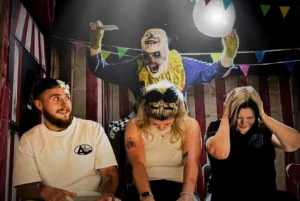
Haunted house adventures are almost always done in groups, and that’s no accident. Fear is deeply social. When you see someone else react with terror, your threat response mirrors theirs through a process called emotional contagion.
A friend screaming next to you doesn’t just signal danger – it validates your own fear response. Suddenly, the haunted property you’re moving through feels far more threatening, even if you didn’t find the last room particularly scary.
Laughter as a Pressure Valve
You’ve probably noticed that people laugh at horror attractions. That’s not because it’s funny – it’s because laughing is the nervous system releasing built-up tension. It’s a coping mechanism, and it’s completely normal.
Groups that laugh together during ghost stories or haunted hotel experiences tend to bond more quickly. Shared fear is a powerful social connector, which is why these experiences are so popular for team events and birthday groups.
How Good Haunted Attractions Engineer Your Fear Response
Professional haunted house designers, from large haunted landmarks to intimate haunted escape rooms, use a specific set of psychological levers. Understanding them is a little like learning how a magician’s tricks work.
Key Techniques Used in Scary Attractions
- Sensory overload: Noise, darkness, unexpected touch and smell short-circuit rational thinking.
- Pacing and rhythm: Building dread slowly, then releasing it suddenly, keeps adrenaline levels high throughout.
- Character psychology: Actors who hold eye contact or move unpredictably are far more unsettling than those who simply jump out.
- Environmental storytelling: A half-eaten meal or an open diary suggests a story that your brain rushes to complete, usually in the worst possible direction.
- Liminal spaces: Doorways, corridors and thresholds between rooms create a primal discomfort. We’re wired to feel uneasy in transition zones.
Top horror attractions and paranormal investigations lean on all of these tools at once. The result is an experience your nervous system treats as genuinely threatening, even when your rational mind knows better.
Why Some People Love Fear More Than Others
Not everyone runs toward scary attractions. Research consistently shows that people vary significantly in what psychologists call sensation seeking, which is a drive for novel, intense experiences.
High sensation seekers tend to love haunted house experiences because the adrenaline payoff outweighs the discomfort. Lower sensation seekers may find the same experience overwhelming rather than exhilarating.
Interestingly, previous exposure to supernatural sites and ghost hunting locations tends to lower the fear threshold over time. The more haunted house tours you do, the better your brain gets at categorising the experience as thrilling rather than threatening.
The Role of Ghost Stories and Cultural Priming
Ghost stories and supernatural narratives prime us to be afraid of specific things: the dark, the dead, the unknown. Cultural conditioning plays a huge role in what we find scary and why.
A haunted estate that taps into shared cultural fears, like the ghostly mansion trope, the vengeful spirit, or the abandoned asylum, is activating stored mental associations built up over a lifetime of stories and films.
The Bottom Line
A haunted house works because your brain can’t fully override its survival instincts, even when you’re completely safe. The fear is physiological, the relief is chemical, and the whole experience is a reminder of just how fascinating the human nervous system is.
Haunted attractions aren’t just fun. They’re a workout for your threat-response system, a bonding experience with the people beside you, and proof that a well-crafted scare is one of the most memorable things you can do.
Ready to put the psychology to the test?