
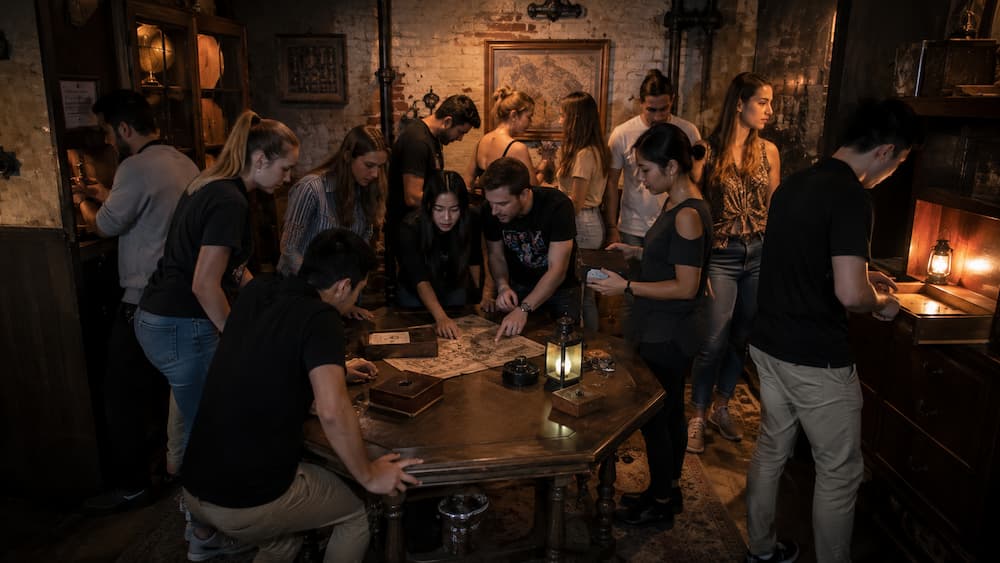
More hands should mean an easier win, right? Not quite. Booking an escape room for big groups changes the whole dynamic of the game, sometimes making things easier and sometimes making them a lot harder.
Whether you’re planning a birthday bash, a corporate outing or a big family get-together, understanding how team size shapes the experience helps you pick the right room and set the right expectations before you walk in.
How Group Size Affects Escape Room Difficulty
It’s a common assumption that more players automatically means a faster win. In reality, escape room difficulty by players is a bit more complicated than that.
Smaller teams tend to move through puzzles in a fairly linear way, with everyone aware of what’s been tried and what hasn’t. Larger teams can split up and tackle multiple puzzles at once, which speeds things up, but only if everyone stays on the same page.
Small vs Large Escape Room Teams
Small vs large escape room teams each come with their own strengths. Small groups usually communicate more easily, since there’s less noise and fewer conversations happening at once.
Large teams, on the other hand, bring more brainpower and more hands to search, sort and solve. The tradeoff is that team size and puzzle-solving speed only improve when the group manages to stay coordinated rather than splintering into confusion.
Multiplayer Escape Room Dynamics: Communication Is Everything
The biggest factor in how well a large group performs isn’t the number of people; it’s how well they communicate. Escape room communication challenges tend to grow as group size increases, simply because there’s more information moving around at once.
Without a clear system, big groups can end up duplicating work, missing clues that someone else already found, or talking over each other at the worst possible moment.
Escape Room Teamwork Strategy for Big Groups
A solid escape room teamwork strategy usually involves splitting into smaller sub-teams, each responsible for a different area or puzzle type. Appointing one or two people to keep track of solved clues and outstanding tasks also helps keep the whole group aligned.
This kind of structure turns a large-team puzzle-solving game from chaotic into properly efficient, without losing the fun of having a big group along for the ride.
What’s the Optimal Group Size for Escape Rooms?
There’s no single answer to the optimal group size for escape rooms, since it depends heavily on the room design and story. Some rooms are built with smaller, tighter teams in mind, while others are specifically designed as an escape room for big teams, with multiple areas to explore at once.
As a general guide, most standard rooms work well with anywhere from four to eight players. Larger rooms designed for bigger bookings can often comfortably handle ten or more, especially when the space and puzzle count are built to match.
Avoiding Escape Room Overcrowding Issues
Escape room overcrowding issues usually show up when a group is too large for the physical space or the number of puzzles available. This can lead to some players standing around with little to do, which affects escape room participation balance for the whole group.
Choosing a room specifically designed for bigger bookings, rather than squeezing a large group into a room built for six, makes a noticeable difference to how enjoyable the session feels for everyone.
Tips for Booking an Escape Room for Big Groups
A bit of planning goes a long way when you’re organising a session for a larger crew.
- Check the room’s recommended capacity. Rooms designed for big teams usually list their ideal player range, so it’s worth confirming before you book.
- Assign informal roles early. A quick chat before the timer starts, covering who’s searching where, saves confusion later.
- Split into sub-teams for larger puzzles. This keeps escape room efficiency with more players high, since everyone has something to focus on.
- Nominate a communicator or two. Having a couple of people responsible for sharing progress keeps the whole group in the loop.
- Choose a venue built for bigger bookings. Multiple rooms or larger layouts help avoid overcrowding and keep everyone involved.
How Padlock’d Handles Escape Rooms for Big Groups
Padlock’d in Surfers Paradise is well set up for an escape room for big groups, offering a range of room sizes and multiple venues to suit everything from small friend groups to large corporate teams.
For bigger bookings, staff can help match your group to a room designed with escape room group performance in mind, ensuring there’s enough space and enough puzzles to keep everyone engaged rather than waiting around. This makes it a strong option for birthday parties, school groups and corporate team-building events where the guest list runs long.
Larger groups can also make use of the on-site bar and function space before or after their session, turning the escape room into just one part of a bigger event.
Final Thoughts
Group size changes the entire feel of an escape room, from how puzzles get divided up to how much communication a team needs to succeed. Whether you’re bringing a tight group of four or organising an escape room for big groups with twenty people on the guest list, matching the room to your numbers is what really determines how much fun the session ends up being.
If you’re planning a bigger booking, it’s worth chatting with the team at Padlock’d before you lock in a date. Head to the FAQ page to check group size recommendations for each room, or get in touch directly if you’re organising something larger, like a corporate event or a big birthday crew, and want help picking the right fit. Once you’ve settled on numbers, you can book your room at Padlock’d’s Surfers Paradise venues and get your group organised for a session built around your actual headcount.